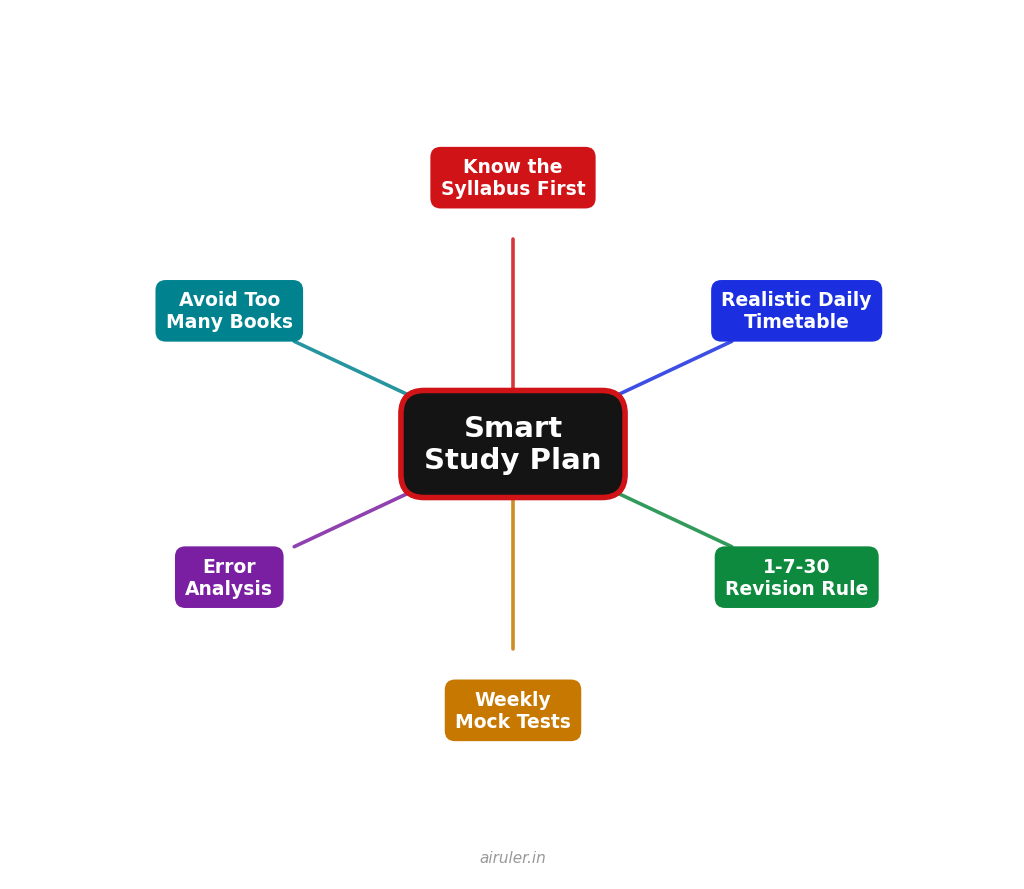
Every year lakhs of aspirants prepare for competitive exams — SSC, banking, state public service commissions, railways — but only a small fraction clear them. The difference is rarely intelligence. It is almost always the plan. Toppers follow a system; strugglers follow their mood. When you talk to selected candidates, you hear the same things again and again: a fixed daily routine, ruthless revision, and honest mock-test analysis. None of it is glamorous, and all of it is repeatable. This guide turns those habits into a step-by-step system you can start today, whether you are a fresh graduate with full days available or a working aspirant stealing three hours from a busy schedule.
Step 1: Know the Syllabus Better Than Your Own Name
Most aspirants begin by buying books. Toppers begin by studying the exam itself. Download the official syllabus and the last five years’ question papers from the official exam website — never rely on coaching pamphlets or WhatsApp forwards, which are often outdated. Spend one full day on a simple exercise: go through the papers topic by topic and mark how many questions each topic produced every year.
A clear pattern will emerge. Roughly 20 percent of topics usually produce 80 percent of questions. In SSC exams, for example, a handful of quantitative topics — percentages, ratio, time and work, geometry — dominate year after year, while some chapters barely appear. Your plan must attack the high-yield topics first and give leftover time to the rest. This one day of analysis will save you months of misdirected effort.
Step 2: Build a Realistic Daily Timetable
Forget the 14-hour-study posters on social media. A sustainable plan beats a heroic one, because exams are won over months, not weekends. A working aspirant can absolutely succeed with 3 genuinely focused hours daily; a full-time aspirant should aim for 6–7 hours of real work, not 12 hours of sitting at the desk with a phone nearby.
- Morning (fresh mind): attack the toughest scoring subject — quantitative aptitude or reasoning. Difficult practice needs your best mental energy.
- Afternoon: theory subjects — polity, history, geography, general awareness. Reading-heavy work suits the post-lunch hours.
- Evening: pure practice — previous year questions and one sectional test with a timer.
- Night (20 minutes): a quick revision of everything you touched that day. This tiny habit multiplies retention.
Here is how the same system scales for different situations:
| Aspirant type | Daily hours | How to split |
|---|---|---|
| Working professional | 3 hours | 1 hr morning concept + 1.5 hr evening practice + 30 min revision |
| College student | 4–5 hours | 2 hr concepts + 2 hr practice + 30–60 min current affairs and revision |
| Full-time aspirant | 6–7 hours | 3 hr concepts + 3 hr practice/mocks + 1 hr revision and analysis |
Also plan your week, not just your day: six days of study, and the seventh reserved for a full mock test plus complete weekly revision. Rest is part of the plan — burnout has ended more attempts than any tough paper.
Step 3: The 1-7-30 Revision Rule
Memory research is brutally clear: we forget most new material within days unless we revisit it. This is why aspirants who “finished the syllabus” still blank out in the exam hall — they finished it once, months ago. Use the 1-7-30 rule: revise a topic the next day, again after seven days, and again after thirty days.
Make this practical with a one-page-per-topic notebook containing only formulas, dates, exceptions and one-line facts — no long paragraphs. A topic’s revision should take five minutes, not an hour. Aspirants who follow this rule walk into the exam with the whole syllabus fresh; aspirants who don’t walk in with only last month’s topics fresh and everything else fading.
Step 4: Mock Tests Are the Real Preparation
Reading feels like progress; testing is progress. From day one, attempt at least one previous-year paper every week, even if you score badly — early scores don’t matter, calibration does. In the final two months, move to one full mock every alternate day at the same time slot as your actual exam, so your brain learns to perform at that hour.
The mock itself is only half the work. After every test, spend twice the test’s duration analysing it: Which questions did I get wrong, and why — concept gap, silly mistake, or time pressure? Which correct answers took too long? Which questions should I have skipped? Maintain an error notebook and read it before every next mock. A mistake understood once is a mark gained forever; a mistake ignored is a mark lost repeatedly.
Step 5: Handle Current Affairs Daily, Not Desperately
The single most common regret among failed attempts is leaving current affairs for the last month, then drowning in twelve months of compilations. The fix costs 30 minutes a day: one daily current affairs video or PDF from a trusted source, plus a two-line note per important event in your own words. On Sundays, revise the week’s notes. By exam time you will have revised the entire year’s events several times without ever cramming.
Step 6: Avoid the Three Classic Mistakes
One, collecting ten books per subject. One standard book revised five times beats five books read once — depth of revision, not breadth of material, produces marks. Two, constantly switching targets after every notification; pick your primary exam and let overlapping syllabi cover the rest. Three, preparing in complete isolation. Join one serious Telegram group or a small study circle — not for gossip, but for accountability, doubt-solving and timely exam updates. Beware of paid “guaranteed selection” batches and shortcuts; there are none.
If your target is a government job, see our complete government job exam roadmap for beginners to choose the right exam first. And to speed up note-making, practice-question generation and revision, these free AI tools for students can genuinely save hours every week when used with discipline.
A 90-Day Starter Framework
If you are starting from zero, structure your first three months like this. Days 1–30: cover the high-yield 20 percent of topics identified in Step 1, with one previous-year paper weekly. Days 31–60: complete the remaining syllabus while running the 1-7-30 revision cycle on everything already done. Days 61–90: shift the balance to two-thirds practice and one-third revision, with full mocks every alternate day in the final fortnight. Aspirants who complete one honest 90-day cycle are usually shocked at the transformation in their mock scores.
FAQ
How many hours should I study daily?
Consistency beats intensity. Three genuinely focused hours daily for a year outperforms ten distracted hours that collapse within a month. Choose a number you can sustain even on your worst day.
Should I join coaching or self-study?
Both routes produce toppers. If you are disciplined and use official syllabi, standard books, free lectures and mock tests, self-study is enough for most exams. Coaching helps those who need external structure and doubt support.
When should I start mock tests?
Immediately — even before finishing the syllabus. Early mocks reveal your true level, teach time management, and build exam temperament that no amount of reading can.
How do I manage preparation with a full-time job?
Fix a non-negotiable 3-hour block (early morning works best), use commute time for current affairs audio or revision notes, and protect weekends for mocks. Thousands of selected candidates prepared exactly this way.
What should I do when scores stop improving?
A plateau almost always means an analysis gap, not an effort gap. Go back to your error notebook, identify the two weakest recurring areas, and give them one focused week each while maintaining regular revision. Scores move when weaknesses are attacked specifically.